LVIS™ — LV Image Integrity System™ — Professional Forensic Image Analysis
Integrity you can verify.
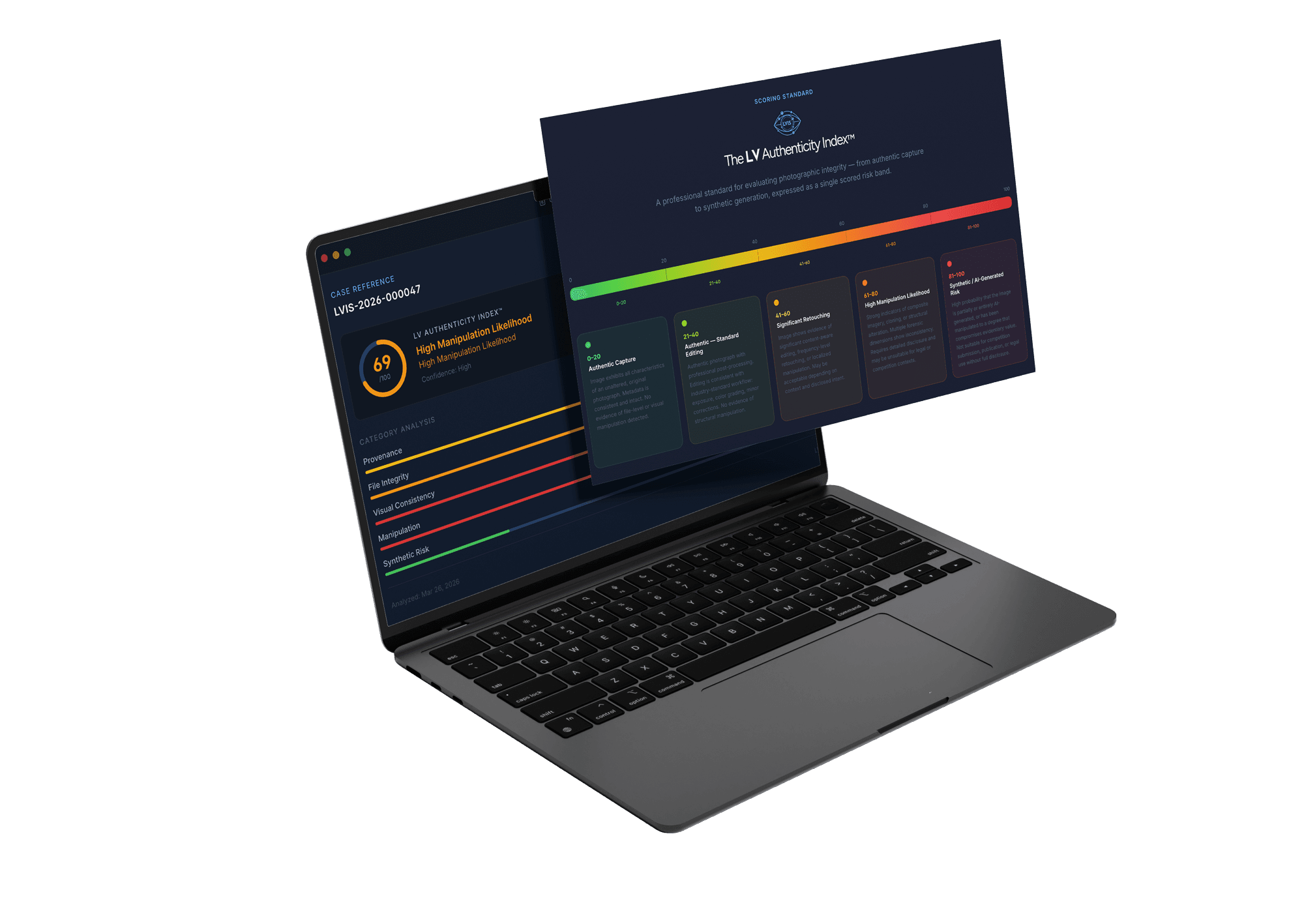
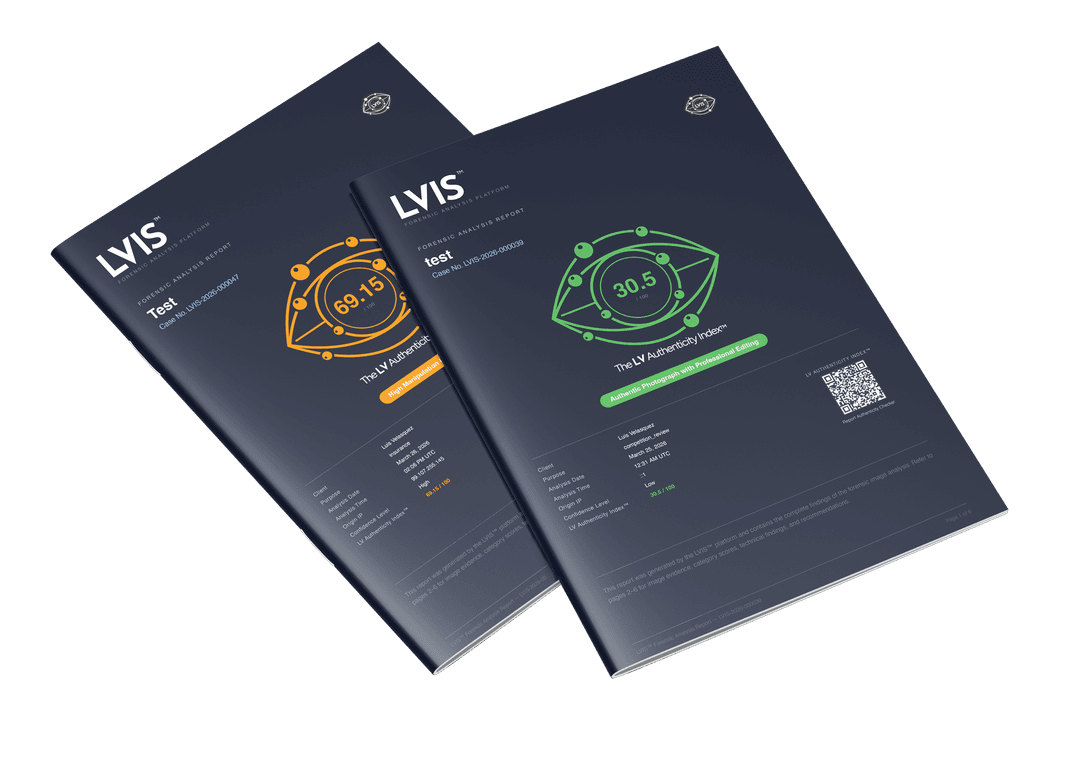
LVIS™ delivers structured, evidence-based forensic analysis of photographic images. Using the proprietary LV Authenticity Index™, every image is evaluated across five critical dimensions — provenance, file integrity, visual consistency, manipulation likelihood, and synthetic risk — producing a defensible risk score for professional and legal contexts.
The Challenge
The Problem We Solve
In an era of AI generation and invisible manipulation, visual trust is collapsing. Professionals operating in legal, editorial, and competitive contexts need more than an opinion — they need evidence.
AI-Generated Images Are Indistinguishable
Modern generative AI produces synthetic images that are visually indistinguishable from authentic photographs. Without technical forensic analysis, no professional can reliably identify them by eye alone.
Manipulation Is Invisible to the Naked Eye
Sophisticated retouching, cloning, compositing, and metadata stripping leave no obvious visual traces. Images routinely pass publication or legal review despite significant manipulation.
Competitions Lack a Standard
Photography competitions have no universally accepted technical standard for image evaluation. Judges rely on subjective impression rather than structured forensic evidence — creating inconsistency and dispute.
Legal Proceedings Need Defensible Evidence
Courts, investigators, and insurers require structured, reproducible documentation. An opinion is not evidence. The LV Authenticity Index™ produces a risk-scored, methodology-backed report that holds up under professional scrutiny.
LVIS™ was created to fill this gap — a structured, methodology-driven platform that produces reproducible, evidence-based image integrity assessments professionals can rely on and cite.
Methodology
How LVIS™ Works
A structured methodology developed through professional photographic practice and technical analysis. Each dimension produces a scored indicator that feeds the LV Authenticity Index™.
Provenance Analysis
Examination of camera metadata, timestamps, GPS data, and software edit history to establish image origin and chain of custody.
- EXIF / XMP / IPTC metadata extraction
- Timestamp cross-validation
- Camera model and firmware fingerprinting
- Software history reconstruction
File Integrity Inspection
Low-level binary analysis of file structure, compression artifacts, and encoding anomalies to detect alteration at the file layer.
- JPEG compression analysis
- File header and trailer validation
- Encoding inconsistency detection
- Hash verification against originals
Visual Consistency Evaluation
Technical assessment of lighting physics, shadow geometry, perspective consistency, and lens characteristics throughout the image.
- Light source direction mapping
- Shadow geometry verification
- Perspective and horizon analysis
- Lens distortion profiling
Manipulation Detection
Identification of cloning, healing, compositing, frequency-domain anomalies, and retouching artifacts across the image surface.
- Clone stamp and healing brush detection
- Error Level Analysis (ELA)
- Frequency domain anomaly mapping
- Compositing edge detection
Synthetic Risk Assessment
Evaluation of AI-generation signatures including texture regularity, noise pattern inconsistency, and generative model fingerprints.
- AI texture pattern analysis
- Noise distribution mapping
- GAN / diffusion model fingerprinting
- Semantic coherence evaluation
All five dimensions are weighted and combined to produce the final LV Authenticity Index™ score — a single, defensible risk rating from 0 to 100.
Scoring Standard
A professional standard for evaluating photographic integrity — from authentic capture to synthetic generation, expressed as a single scored risk band.
0–20
Authentic Capture
Image exhibits all characteristics of an unaltered, original photograph. Metadata is consistent and intact. No evidence of file-level or visual manipulation detected.
21–40
Authentic — Standard Editing
Authentic photograph with professional post-processing. Editing is consistent with industry-standard workflow: exposure, color grading, minor corrections. No evidence of structural manipulation.
41–60
Significant Retouching
Image shows evidence of significant content-aware editing, frequency-level retouching, or localized manipulation. May be acceptable depending on context and disclosed intent.
61–80
High Manipulation Likelihood
Strong indicators of composite imagery, cloning, or structural alteration. Multiple forensic dimensions show inconsistency. Requires detailed disclosure and may be unsuitable for legal or competition contexts.
81–100
Synthetic / AI-Generated Risk
High probability that the image is partially or entirely AI-generated, or has been manipulated to a degree that compromises evidentiary value. Not suitable for competition submission, publication, or legal use without full disclosure.
Important Limitation
The LV Authenticity Index™ does not determine truth. It documents evidence and assigns risk based on measurable technical indicators. A score in any band is a structured forensic assessment — not a legal conclusion, not a statement of intent, and not a determination of deception. Results must be interpreted within professional and contextual frameworks by qualified practitioners.
Clients and Use Cases
Who Uses LVIS™
LVIS™ serves professionals across photography, media, education, and law — wherever image integrity must be documented, defended, and trusted.
Photography Competitions
Verify submissions against competition rules with forensic rigor. Support fair judging with evidence-based integrity assessments rather than subjective impression. Establish a defensible standard for disqualification or certification.
Editors and Media Organizations
Evaluate authenticity before publication. Identify AI-generated content, undisclosed composites, and significant manipulation in submitted or sourced imagery before it reaches your audience.
Photographers
Validate your own work and protect your professional credibility. Obtain a certified integrity report for images submitted to competitions, clients, or legal proceedings — demonstrating transparency and professional standards.
Educational Institutions
Teach visual integrity and photographic ethics with a structured technical framework. Use the LV Authenticity Index™ as a curriculum tool for understanding image forensics, AI detection, and professional standards.
Investigators and Legal Professionals
Document evidence and support legal decisions with structured, reproducible forensic reports. LVIS™ analysis follows a consistent methodology — producing reports suitable for evidentiary reference, expert consultation, and investigative documentation.
What We Offer
Services
Professional forensic image analysis delivered at the level of rigor demanded by legal, editorial, and competitive contexts.
Image Integrity Analysis
Full five-dimension forensic analysis of a photographic image. Covers provenance, file integrity, visual consistency, manipulation detection, and synthetic risk. Produces a complete LV Authenticity Index™ report with scored findings and supporting documentation.
Competition Submission Verification
Structured analysis designed for photography competitions. Evaluates submissions against stated competition rules with a focus on manipulation detection and synthetic content identification. Delivers a determination-ready assessment report.
Retouching and Manipulation Detection
Focused analysis for images where manipulation is the primary concern. Applies Error Level Analysis, frequency domain inspection, and cloning detection to identify and map specific areas of alteration.
AI-Generated Image Assessment
Specialized evaluation for identifying generative AI signatures in images submitted as photographs. Examines noise patterns, texture regularity, semantic coherence, and known model fingerprints.
Expert Opinion Reports
Formal written expert opinion prepared for legal proceedings, insurance claims, or institutional review. Produced under professional methodology, structured for evidentiary reference and expert consultation use.
Ready to Verify Image Integrity?
Whether you need forensic analysis for a legal proceeding, a competition review, or editorial publication — LVIS™ delivers structured, evidence-based results.
Free tier available — no credit card required. See pricing for all plans.